On this page
- How much does a car weigh on average?
- Average car weight by class
- Curb weight of popular cars in 2025
- Why one model can weigh 500 pounds more
- Curb weight vs gross vehicle weight
- Why car weight matters on the road
- Why car weight sets your scrap value
- How much a typical junk car weighs
- How to find your car’s exact weight
- Turn the weight into a real offer
The answer to “how much does a car weigh” is 2,900 to 4,500 pounds for most cars, about 1.5 to 2.25 US tons. That curb weight sets your scrap-only floor at the yard.
The average new vehicle runs near 4,050 pounds. Cars headed to the junkyard are mostly 2005 to 2015 models (our estimate), and EPA data put new cars from those years at roughly 3,700 to 3,800 pounds at the curb.
Quick answer
2,900 – 4,500 lbcurb weight for most cars
Divide your car’s weight by 2,000, then multiply by the yard’s price per ton. That is the scrap-only floor. Compacts sit near 3,000 pounds and full-size SUVs near 5,450.Free online quotes. Free towing. Compare two offers before you say yes.
 Best overall Towing: free
 Peddle
Instant online offer for junk, damaged, and running cars in all 50 states.
- Best for
- Most junk cars, including ones without a title
- Payment
- Usually a check at pickup
- No title?
- Sometimes OK. Tell them up front
- Coverage
- All 50 states
- Offer shows on screen in a few minutes
- No fees. Towing and title transfer included
- Cancel any time, even after you accept
Watch for: Offer can drop at pickup if the car does not match what you entered.
Get my Peddle offer Best for wrecked cars Towing: free
 CarBrain
Buys wrecked, flooded, and mechanically dead cars as-is, often for more than scrap.
- Best for
- Accident damage, blown engines, newer cars that died
- Payment
- Check at pickup
- No title?
- Needed in most states
- Coverage
- 48 states (not AK or HI)
- Quote in about 90 seconds for many cars
- Offer held for up to 7 days
- Pickup usually 24 to 48 hours after you accept
Watch for: Needs the title in your name in most cases. Missing parts lower the price.
Get my CarBrain offerWe earn a commission if you sell through some links on this page. It never changes what we recommend. How we make money.
How much does a car weigh on average?
EPA puts the average new vehicle at 4,354 pounds for model year 2024, just under the record. Preliminary 2025 data say 4,441. Those are inertia weights, which are curb weight plus 300 pounds, so average curb weight is roughly 4,050 pounds (our subtraction, not an EPA figure).
Cars have gotten heavier. On the same inertia basis, EPA’s fleet average was 3,228 pounds in 1980, 3,821 in 2000 and 4,166 in 2020. In model year 2024 the average pickup outweighed the average sedan or wagon by about 1,700 pounds.
Does a car weigh 1 ton?
Almost never. The lightest 2025 sedan in our tables, the Honda Civic LX at 2,877 pounds, is about 1.4 US tons. A full-size SUV is closer to 2.7.
Average car weight by class
No source publishes an official average for every size class. The table shows the spread on the 2025 spec pages we read, mostly base trims, with a ballpark in the middle. The ballparks are our judgment. The full-size sedan row uses a 2022 Toyota Avalon (3,570) and a 2023 Chrysler 300 (4,013).
| Class | Range read (lb) | Ballpark (lb) | US tons |
|---|---|---|---|
| Compact car | 2,877–3,252 | 3,000 | 1.5 |
| Midsize sedan | 3,239–3,450 | 3,350 | 1.7 |
| Small SUV | 3,370–3,737 | 3,500 | 1.8 |
| Full-size sedan | 3,570–4,013 | 3,800 | 1.9 |
| Compact pickup | 3,856–4,295 | 4,000 | 2.0 |
| Midsize pickup | 4,145–4,204 | 4,200 | 2.1 |
| Midsize SUV | 4,155–4,344 | 4,250 | 2.1 |
| Minivan | 4,521–4,610 | 4,550 | 2.3 |
| Full-size pickup | 4,288–4,894 | 4,700 | 2.4 |
| Full-size SUV | 5,383–5,530 | 5,450 | 2.7 |
EPA publishes only five vehicle types, and only as a chart. Reading its model year 2024 chart (give or take 100 pounds) and subtracting the 300-pound inertia allowance gives roughly 3,200 for sedans and wagons, 3,650 for car SUVs, 4,200 for truck SUVs, 4,400 for minivans and 4,900 for pickups. That lands within a few hundred pounds of our table.
Curb weight of popular cars in 2025
Each figure is the curb weight for the trim the spec page shows, taken from Honda’s spec sheet, cars.com and The Car Connection. That trim is usually the light end of the model, so the car in your driveway may run heavier.
| Model | Class | Trim | Curb weight (lb) |
|---|---|---|---|
| Honda Civic Sedan | Compact | LX | 2,877 |
| Toyota Corolla | Compact | LE CVT | 2,955 |
| Honda Accord | Midsize sedan | LX CVT | 3,239 |
| Nissan Altima | Midsize sedan | S FWD | 3,255 |
| Toyota RAV4 | Small SUV | LE FWD | 3,370 |
| Toyota Camry | Midsize sedan | LE | 3,450 |
| Honda CR-V | Small SUV | LX 2WD | 3,472 |
| Ford Maverick | Compact pickup | XL AWD SuperCrew | 3,856 |
| Toyota Tacoma | Midsize pickup | SR XtraCab | 4,145 |
| Toyota Highlander | Midsize SUV | LE FWD | 4,155 |
| Chevrolet Silverado 1500 | Full-size pickup | WT 2WD Reg Cab | 4,288 |
| Ford Explorer | Midsize SUV | Active RWD | 4,344 |
| Ford F-150 | Full-size pickup | XL 2WD Reg Cab | 4,396 |
| Honda Odyssey | Minivan | EX-L | 4,526 |
| Ram 1500 | Full-size pickup | Tradesman 4x2 Quad Cab | 4,838 |
| Chevrolet Tahoe | Full-size SUV | LS 2WD | 5,383 |
Do hybrids and electric cars weigh more?
Yes, and the battery is why. Honda lists the 2025 Civic Sport at 2,935 pounds and the Sport Hybrid at 3,208, a gap of 273. Electric cars stretch it further. CNN reported in 2021 that the electric F-150 Lightning would weigh about 1,600 pounds more than a similar gas F-150, and the Volvo XC40 Recharge about 1,000 more than the gas XC40.
Why one model can weigh 500 pounds more
A spec page shows one weight, for the trim it highlights. AWD or 4x4, a hybrid battery, a crew cab or a bigger engine add roughly 100 to 500 pounds.
The Ford F-150 shows the spread. An XL 2WD regular cab is 4,396 pounds. A King Ranch 2WD SuperCrew is 4,894. That is 498 pounds inside one model name, so look up your exact trim before you do any math.
Curb weight vs gross vehicle weight
Curb weight is the empty car: standard equipment plus fuel, oil and coolant at maximum capacity. NHTSA’s definition (49 CFR 571.3) counts no passengers or cargo. Spec sheets list it, and it is the number to use for scrap math.
Gross vehicle weight rating (GVWR) is the manufacturer’s stated loaded weight, passengers and cargo included. The gap is payload room. A 2025 F-150 XL 2WD regular cab has a 4,396-pound curb weight and a 6,220-pound GVWR, so the truck is rated to carry about 1,800 pounds.
The door sticker is not curb weight
The certification label by the driver’s door lists GVWR and axle ratings, not curb weight (49 CFR 567.4). GVWR always runs higher than the empty car, so using it inflates your scrap estimate. EPA’s headline 4,354 pounds is also inertia weight, not curb weight.Why car weight matters on the road
Weight shows up at the pump. The Department of Energy’s fueleconomy.gov says an extra 100 pounds in your vehicle could reduce your MPG by about 1%, and the hit is bigger on smaller vehicles.
It matters in a crash too. CNN’s 2021 report cites insurance claim statistics showing people in electric vehicles are less likely to be injured than people in similar gas vehicles, with hybrids following the same pattern. The catch is the other car, which absorbs the extra impact force. CNN’s own section title sums it up: heavier is better, but only for those inside.
Why car weight sets your scrap value
Yards price a complete car by the ton, and their scale reads the car as delivered. As of September 2026, most US yards pay about $140–$200 per ton. iScrap, a crowd-sourced price site, puts its average at $177.58 (its newest yard report is dated September 16). Until you call a yard, curb weight is your best stand-in for the scale reading.
Location moves the number. Seven of iScrap’s last nine complete-car yard reports, from June to September 2026, sat between $150 and $170 per ton. The other two, in Rapid City, South Dakota and Albany, New York, said $250. On a 1.75-ton sedan that is $263 versus $438, so call more than one yard.
To estimate a payout, divide curb weight by 2,000, then multiply by the yard’s per-ton price. Only part of a car’s weight is metal. USGS counted steel and iron at 66.4 percent of the average 2004 car’s weight, down from 87.3 percent in 1970, and the yard’s scale still reads the whole car, fluids and plastic included. Yards can deduct for missing parts or turn down an incomplete car, so treat the result as a starting point for a complete car, not an offer.
Keep the car complete. iScrap counts a complete car as one with its engine, transmission, catalytic converter, battery, radiator, rims and tires, and wiring harness. It warns that selling the converter on its own could reclassify the car as incomplete. Our catalytic converter scrap price guide covers that trade-off.
Worked example: a 3,500-pound sedan
A 3,500-pound midsize sedan is 1.75 tons: about $263 at $150 per ton, $311 at iScrap’s $177.58 and $350 at $200. The table runs five weights at the same three rates.
| Curb weight | At $150/ton | At $177.58/ton | At $200/ton |
|---|---|---|---|
| 2,500 lb | $188 | $222 | $250 |
| 3,000 lb | $225 | $266 | $300 |
| 3,500 lb | $263 | $311 | $350 |
| 4,000 lb | $300 | $355 | $400 |
| 5,500 lb | $413 | $488 | $550 |
These are our calculations, not published payouts. CarBrain says its junk-car payouts average $250 to $750 (the page is undated), so a buyer that prices make, model and condition can land above the scrap math. Our junk car buyers list compares them.
How much a typical junk car weighs
Most cars reaching yards now are 2005 to 2015 models (our estimate, not a published figure). EPA’s new-vehicle averages for those years ran 3,979 to 4,126 pounds on the inertia basis, so roughly 3,700 to 3,800 at the curb.
Expect the real junk pile to run a bit lighter, because it likely leans toward smaller sedans and EPA counts only new vehicles. A 3,750-pound car is 1.875 tons, or about $281–$375 at $150–$200 per ton. Start there, then look up your own trim.
How to find your car’s exact weight
- Search your year, make, model and trim on cars.com’s research pages or the manufacturer’s spec sheet. Match the drivetrain and engine too. Honda’s newsroom, for example, lists curb weight by Civic trim.
- Check the owner’s manual, which can list it in the specifications section.
- Skip the door sticker. It shows GVWR.
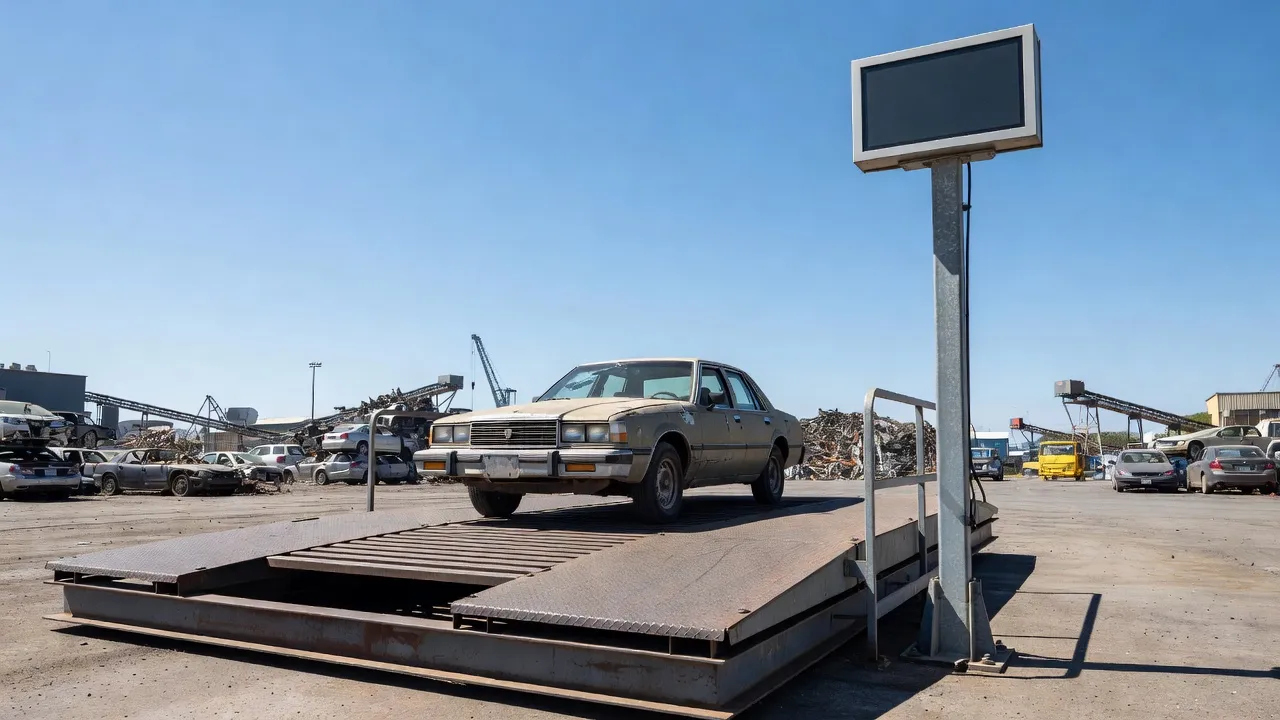
- Weigh it. A weighbridge (vehicle scale) gives the true figure, and a yard weighs your car at drop-off anyway.
Not worth the trouble? Peddle’s flow asks for year, make, model, optional trim and condition. CarBrain’s FAQ lists make, model, mileage and damage among its offer inputs. Neither flow asks for a weight.
Turn the weight into a real offer
Weight gives you a floor. Parts demand, location, the catalytic converter and your title decide the rest.
- Run the numbers with the table above or our junk car value calculator.
- Check them against what yards are paying in our scrap car prices guide and our page on what junkyards pay for cars.
- Request offers below from both companies. Both are free and you can decline. Either can revise an offer at pickup if the car does not match your answers.
- Take the higher number. Our page on cash for junk cars and our steps to sell your junk car cover pickup and paperwork.
Free online quotes. Free towing. Compare two offers before you say yes.
Best overall Towing: free Peddle
Instant online offer for junk, damaged, and running cars in all 50 states.
- Best for
- Most junk cars, including ones without a title
- Payment
- Usually a check at pickup
- No title?
- Sometimes OK. Tell them up front
- Coverage
- All 50 states
- Offer shows on screen in a few minutes
- No fees. Towing and title transfer included
- Cancel any time, even after you accept
Watch for: Offer can drop at pickup if the car does not match what you entered.
Get my Peddle offer Best for wrecked cars Towing: free CarBrain
Buys wrecked, flooded, and mechanically dead cars as-is, often for more than scrap.
- Best for
- Accident damage, blown engines, newer cars that died
- Payment
- Check at pickup
- No title?
- Needed in most states
- Coverage
- 48 states (not AK or HI)
- Quote in about 90 seconds for many cars
- Offer held for up to 7 days
- Pickup usually 24 to 48 hours after you accept
Watch for: Needs the title in your name in most cases. Missing parts lower the price.
Get my CarBrain offerWe earn a commission if you sell through some links on this page. It never changes what we recommend. How we make money.
FAQ
Does a car weigh 1 ton?
Almost never. A US ton is 2,000 pounds, and the lightest 2025 sedan in our tables, the Honda Civic LX, weighs 2,877 pounds, about 1.4 tons. Most cars land between 1.5 and 2.25 tons, and full-size SUVs pass 2.5. Even a metric ton (2,205 pounds) sits below every car we checked. Divide curb weight by 2,000 to get US tons for scrap math.
What car weighs 2,000 pounds?
None that we checked. The lightest 2025 model in our tables, the Honda Civic LX, weighs 2,877 pounds. A weightofstuff.com list of small cars near 2,500 pounds (Ford Fiesta, Toyota Prius C, Kia Rio, Honda Fit, Hyundai Accent) shows where the light end sits. For an exact figure on an older car, check its spec sheet or have a yard weigh it.
Is 3,000 pounds heavy for a car?
No, it is on the light side. A 2025 Toyota Corolla LE weighs 2,955 pounds and a Honda Accord LX 3,239, while the average new vehicle is roughly 4,050 pounds at the curb (EPA's 4,354 minus its 300-pound allowance). As scrap, a 3,000-pound car is 1.5 tons, or about $225–$300 at $150–$200 per ton.
What is curb weight, and does a scrap yard use it?
Curb weight is the empty car with standard equipment and fuel, oil and coolant at maximum capacity, but no passengers or cargo. A yard weighs your car on its own scale at drop-off, so curb weight is a good estimate, not the final number. Missing parts lower the reading, and iScrap warns that selling the catalytic converter separately could reclassify your car as incomplete. The door sticker shows GVWR, not curb weight.
How much is a 4,000-pound car worth as scrap?
A 4,000-pound car is 2 tons, so about $300 at $150 per ton, $355 at iScrap's September 2026 average of $177.58 and $400 at $200. Those are our calculations for a complete car, not offers. Missing parts or a missing catalytic converter can lower them, and a buyer that prices parts can offer more. Compare before you tow, starting with our scrap car prices guide.
Sources we checked
- EPA: 2025 Automotive Trends Report (average vehicle weight, MY2024)
- 49 CFR 571.3: definitions of curb weight and GVWR
- 49 CFR 567.4: vehicle certification label contents
- Honda Newsroom: 2025 Civic Sedan specifications
- cars.com: 2025 Ford F-150 specs
- iScrap App: Complete Car scrap price per ton
- USGS Fact Sheet 2005-3144: Steel stocks in use in automobiles
- fueleconomy.gov: Fuel economy tips (extra weight)

Written and fact-checked by the Junk Car Worth team. Prices and buyer policies checked September 2026. How we estimate value.